 Dataeons
Feature Store vs. Feature Flag
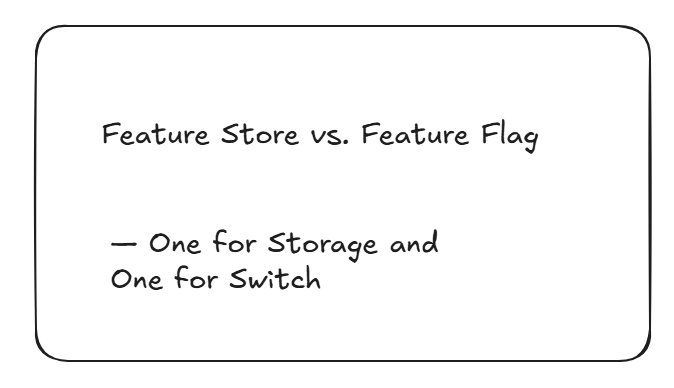
Both terms have "feature" in the name. Both show up in conversations about modern software and ML systems. And yet they have almost nothing to do with each other.
The confusion is purely linguistic. In ML, "feature" means an input variable to a model. In software engineering, "feature" means a product capability — a thing the product can do. Two different fields borrowed the same word for two different purposes.
This post separates them clearly.
1. The One-Line Difference
| Feature Store | Feature Flag | |
|---|---|---|
| What "feature" means | An input variable to an ML model | A product capability (a thing the software can do) |
| Purpose | Supply data to ML models | Control whether a capability is on or off |
| Primary users | Data scientists, ML engineers | Software engineers, product teams |
| Example tool | Feast, Tecton, Hopsworks | GrowthBook, LaunchDarkly, Statsig |
These are not competing tools. They solve different problems at different layers of the stack.
2. What Is a Feature Flag?
A feature flag (also called a feature toggle) is a conditional switch in your code that controls whether a particular capability is active for a given user or group.
The simplest version looks like this:
python
if feature_flag.is_on("new_search_ui", user_id): show_new_search_ui() else: show_old_search_ui()
That's it. The flag lets you deploy code without exposing it — you ship the new UI to production, but keep it turned off until you're ready.
Feature flags become more powerful when combined with experimentation. GrowthBook, for example, lets you tie a flag to an A/B test:
- 50% of users → flag ON → new search UI
- 50% of users → flag OFF → old search UI
- Measure CTR, conversion, session length
- If the new UI wins, gradually ramp the flag to 100%
This is the "gradual rollout" or "controlled release" pattern — and it's the primary use case for tools like GrowthBook.
3. What Is a Feature Store? (Quick Recap)
A Feature Store is the infrastructure layer that manages ML features — the input variables that get fed into models at training and inference time.
When a search ranking model scores products for a given user, it needs data:
- What categories has this user browsed in the last 7 days?
- What's their price sensitivity based on past purchases?
- What's their behavioral embedding (a vector capturing latent preferences)?
The Feature Store holds all of this, pre-computed and ready to serve — consistently across both model training and real-time inference. Its job is to make sure the data your model trained on is the same data it receives when it's running in production.
4. The Real Difference: Where in the Stack They Live
The clearest way to separate them is by where each system sits in the product stack.
User makes a request ↓ [ Feature Flag layer ] ← "Should this user see the new ranking model?" ↓ (if flag is ON) [ ML Inference layer ] ← "Run the ranking model" ↑ [ Feature Store layer ] ← "Here are the input variables the model needs"
Feature flags control what runs. Feature Stores supply what the model needs to run.
They can appear in the same request path — but they're doing completely different jobs at different stages.
5. A Concrete Example: New Search Ranking Model
Suppose your team builds a new ML-based search ranking model and wants to test it against the existing rule-based system.
Feature Flag (GrowthBook):
- Create an experiment:
new_ranking_model - 10% of users → flag ON → routed to the new ML model
- 90% of users → flag OFF → routed to the old rule-based system
- Monitor CTR, conversion, zero-result rate
- If results are positive, ramp to 100%
Feature Store:
- When a user in the 10% group triggers the ML model, the model needs input data
- Feature Store serves: user's recent click history, preferred categories, behavioral embedding, price tier
- These features are pre-computed and available at low latency (sub-10ms)
- The same features were used when the model was trained — no training-serving skew
Neither can substitute for the other. The flag without the Feature Store means you have a way to route users but no data to power the model. The Feature Store without the flag means you have data but no way to control the rollout.
6. The Analogy
Feature Flag = a light switch It controls whether a capability is on or off for a given user. Flipping the switch doesn't change what the room looks like — it just decides whether the lights are on.
Feature Store = a pantry It holds the ingredients a model needs to do its job. The pantry doesn't decide what gets cooked or who eats it — it just makes sure the right ingredients are available when needed.
You can have a switch without a pantry (simple A/B test with no ML). You can have a pantry without a switch (always-on ML model). But in a modern ML-powered product, you usually need both.
7. Why the Confusion Persists
Part of the confusion comes from the fact that some modern experimentation platforms — including GrowthBook and Statsig — now bundle feature flags, A/B testing, and limited feature management into a single tool. When a platform calls itself a "feature management" solution, it's using "feature" in the software sense (product capabilities), not the ML sense (model inputs).
A rough rule of thumb:
- If the tool is primarily about who sees what → it's a feature flag / experimentation tool
- If the tool is primarily about what data the model gets → it's a Feature Store
Takeaway
Feature Store and Feature Flag share a word and nothing else. One manages ML input data. The other controls product capability rollouts. In a modern ML-powered product, they operate at different layers of the same request pipeline — and both are necessary.
One sentence summary:
Feature Flag decides what runs. Feature Store supplies what the model needs to run. The word "feature" just means something different in each field.